The Victorian arcades of Leeds - a walking guide
Glass roofs and ironwork: the covered streets that make Leeds unlike any other northern city.
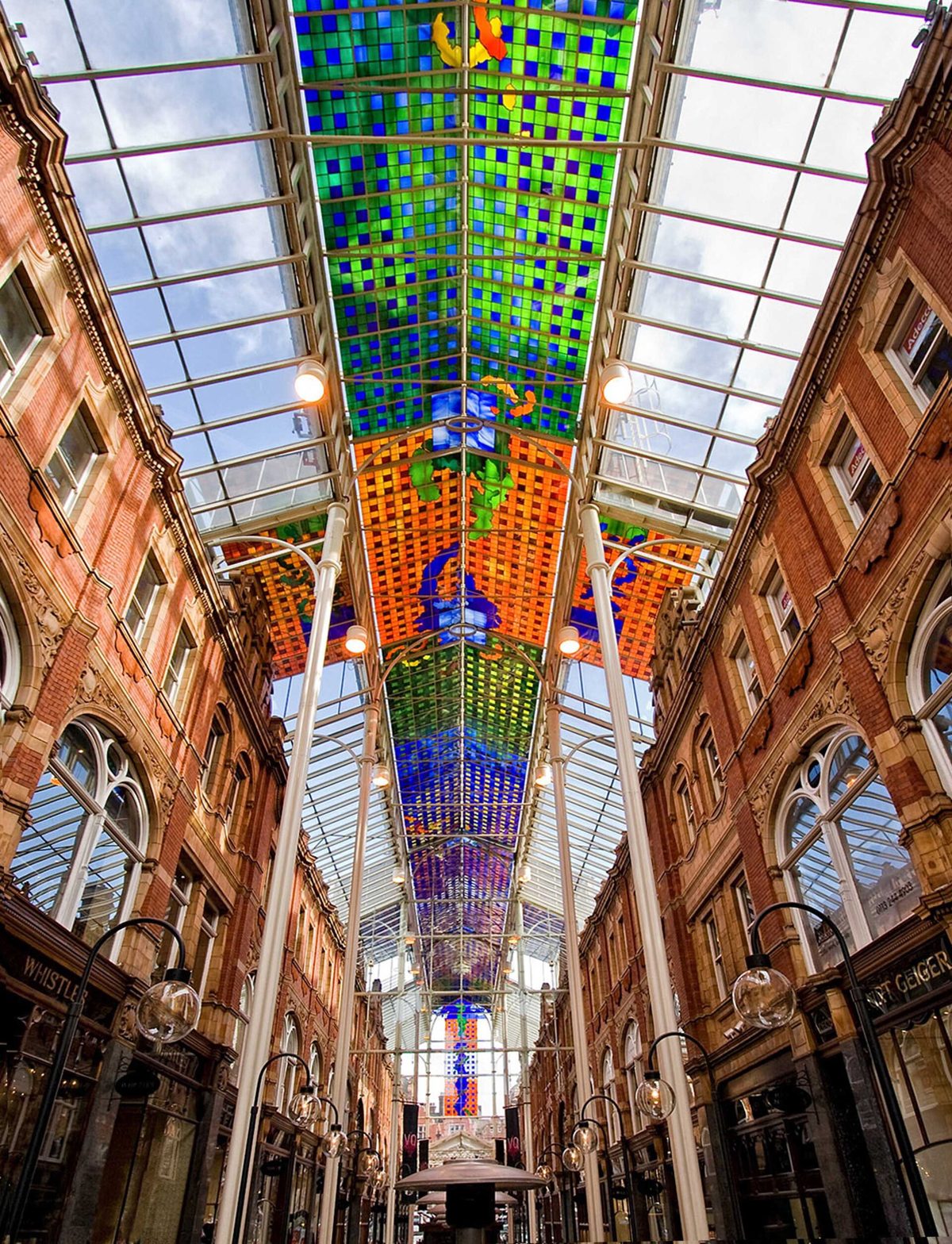
Leeds keeps much of its Victorian and Edwardian commercial architecture in continuous use, so a short walk can move from glass-roofed arcades to a domed corn exchange and a large covered market. This guide covers six real places and what to notice in each.
Thornton's Arcade
Thornton's Arcade was built in the late nineteenth century as a covered pedestrian link between shopping streets, giving Leeds a dry, sheltered route at a time when covered retail passages were fashionable. Look up at the glazed roof and the iron framework that supports it, then at the decorative shopfronts and the arcade clock. Today it remains a retail passage, with small units and cafes along its length.
Queens Arcade
Queens Arcade followed the same Victorian pattern, connecting nearby streets and creating another covered shopping route. Its architecture is best read through the roofline: glass panels, slender iron supports, and the rhythm of shopfronts beneath. The arcade's value lies less in one grand gesture than in the repeated details, from tiled thresholds to decorative brackets. It is still used for retail and small services.
The County Arcade and the Victoria Quarter
The County Arcade forms part of the Victoria Quarter, a group of linked covered shopping streets developed around the turn of the twentieth century. Here the architecture becomes more theatrical: higher glazed roofs, richer decoration, and a stronger sense of procession from one arcade to the next. Look for polished stone, mosaic floors, and ornate ironwork. The area is now used for retail and hospitality in broad terms.
The Grand Arcade
The Grand Arcade is another late Victorian covered passage, built to add capacity and elegance to the city centre's retail network. Its architecture mixes brick, stone, iron, and glass, with a roof that brings daylight deep into the plan. The shopfronts are relatively modest in scale, which helps the arcade feel intimate. It continues to serve as a retail route rather than a single large hall.
The Corn Exchange
The Corn Exchange was built in the mid-nineteenth century as a place for grain trading, reflecting Leeds's role in regional commerce. Its architecture is the most monumental of the group: a large domed or vaulted roof, an oval or elliptical plan, and robust masonry. Stand inside and look at the roof structure and the way light enters. It is now used for retail and events in broad terms.
Kirkgate Market
Kirkgate Market grew from the city's covered market tradition and became one of Leeds's great public trading spaces. Its architecture combines brick walls with a high iron and glass roof, designed to shelter many stalls under one roof. Look at the scale of the hall, the roof trusses, and the way the building organises movement. It remains a working market.
How to walk the route
A simple route keeps the day manageable and avoids backtracking. Start at Thornton's Arcade, then cross to Queens Arcade. Walk through to the County Arcade and the Victoria Quarter. Continue to the Grand Arcade and then the Corn Exchange. Finish at Kirkgate Market, which is close enough to make a natural endpoint.
Frequently asked questions
Which of these places is best for architecture?
The Corn Exchange offers the most monumental single space, while the County Arcade and Victoria Quarter offer the richest decorative sequence. Thornton's Arcade is useful for seeing an earlier, more compact Victorian arcade.
Can I see all six in one walk?
Yes. They are close enough in central Leeds to form one compact route, though you should allow time to look up at roofs, floors, and shopfront details rather than rushing between entrances.
Do these buildings still have their original uses?
Partly. Kirkgate Market remains a market, while the arcades and Corn Exchange have shifted from their original commercial purposes toward broader retail and public use, without losing their historic fabric.
This is an independent member's guide compiled by Leeds Society. We are not affiliated with the venues and institutions mentioned; opening arrangements and programmes change - always confirm details on the official websites before making plans.
← Back to Events